Most embroidery projects take anywhere from 30 minutes for a single simple item to a few weeks for a large bulk order. The exact time depends on design complexity, stitch count, number of items, digitizing, and fabric type.
One of the most common questions that a customer asks before starting with the embroidery classes is:
How long does embroidery take?
Does it take hours to be completed? Or days? The correct answer is that it depends on the design complexity, stitch count, type, and project size.
Understanding these embroidery time factors helps you plan your project efficiently and set realistic expectations for delivery.
Whether you plan to order a single embroidered shirt or hundreds of customized uniforms, it's necessary to know the factors affecting the embroidery time - to avoid delays and achieve the best results in minimal time.
In this blog, we will walk you through the factors affecting embroidery time and what estimated time you should give to your clients when taking any order for embroidery.
Are you excited to unfold these findings with us? Let's get started then.
Here are the embroidery time factors that you should know before starting off the project:
As we said before, factors affecting embroidery time are design complexity. Simple logos or monograms without any additional effort require less effort and fewer stitches, and can be done quickly. Whereas intricate artwork that requires fine detailing, more time, multiple stitching, and a dense filling pattern to create the design would require more time and effort.
Perhaps - design complications are factors affecting embroidery time
Photo-realistic designs sit at the far end of that complexity scale. If you're curious how those pieces are timed and priced differently, our guide on Time Needed for Photo Embroidery breaks it down.
Another factor that affects embroidery speed is the total stitch count. Every embroidery design is made up of thousands of stitches, and the higher the stitch count is, the longer the time for completing the design. Stitch count actually impacts the stitch speed as well. If you have a higher stitch count, then definitely the speed would be slow, as the person will get frustrated and tired. Whereas, a lower stitch count would make the person work instantly, as they know it will be completed in less time.
| Design Level | Stitch Count |
|---|---|
| Simple Design | 3,000 to 8,000 stitches |
| Medium Design | 8,000 to 15,000 stitches |
| Intricate Design | 20,000+ stitches |
Perhaps - Stitch count directly impacts the embroidering speed.
You know, if you get orders in bulk, then definitely your stitching time will be affected. Machine setup and digitizing are two different things, but once completed, each article requires more time to be hooped, embroidered, and finalized for the perfect look.
Therefore, bulk orders take longer to be processed, and if the design is complicated, then it requires time to be processed and meet the deadline.
Perhaps - The number of items also affects the embroidery speed.
Before the process of embroidery starts, artwork should be converted into a machine-readable embroidery file through a process that is called digitizing. If the logo is not digitized properly, then this specific step would add several hours and even an extra business day to your timeline. And you know what? If the firm fails to deliver the item on time, then it will impact your business image.
Perhaps - Digitizing doesn't impact the embroidery speed directly, but it influences the turnaround time.
Fabrics require different embroidery techniques and machine settings. Materials like cotton, denim, and canvas are easier to work with, whereas stretchy and delicate fabrics require stabilizers and slower machine speeds for additional adjustments. Most of the fabric selection is one of the key factors that affect the embroidery time, as the challenging material demands more time and precision.
Not every material behaves the same way under the needle. Our breakdown of File Types That Affect Speed covers how the design file itself changes production time. And if you work with heavier garments, see our guide on Production Time for Denim Patches for fabric-specific timing.
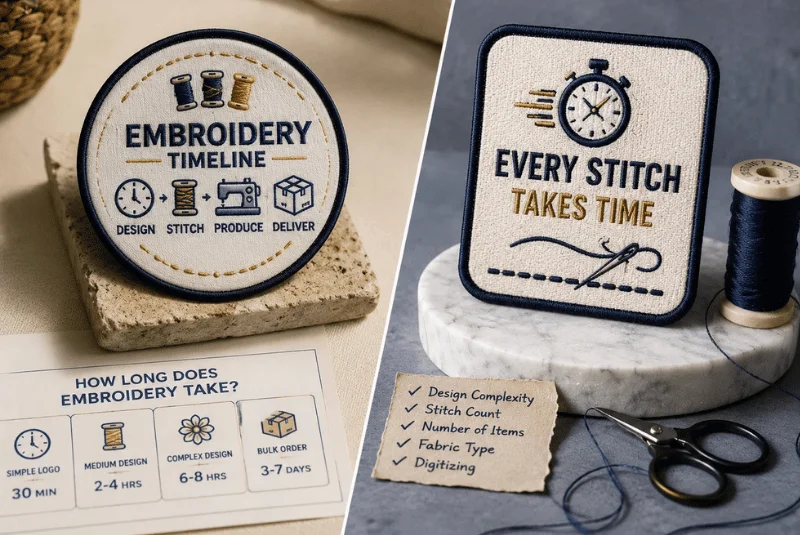
Although different fabrics require different timelines for the embroidery to be done. But here you go with the rough estimate of how long embroidery takes:
| Quantity | Attributes | Time |
|---|---|---|
| Single Custom Item | 1 | 30 minutes to 2 hours |
| Small Order | 10 to 15 | 1 to 3 business days |
| Medium Order | 50 to 250 | 3 to 7 business days |
| Large Bulk Order | 250+ | 1 to 3 weeks |
If you wish to speed up the process, then here are the tips to reduce the time:
And we are done for the day. So, if you are thinking, how long does embroidery take? The answer depends on several factors that we have discussed in the blog. The core quadrants include design complexity, stitch count, garment type, fabric type, personalization, and machine speed, along with efficiency.
By understanding these factors that affect the embroidery time, customers can expect a better estimate for project completion and work with embroidery providers who ensure timely delivery of the items.
If you think we have missed anything within the blog, then feel free to share your thoughts in the comments. We would love to hear from you.
Customer satisfaction is our top priority. Feel free to contact us for any queries or assistance. Looking forward to serving you with our top-notch design services
The average time for embroidery depends on the type of fabric and the complexity of the design. It ranges from a few minutes for a small logo to dozens of hours for complex art pieces.
Embroidery time depends on stitch count, design complexity, and machine speed.
Yes, many embroidery providers offer rush production for an added fee. Simpler designs and smaller quantities are easier to expedite than large, intricate bulk orders.
Yes, if your artwork isn't already digitized, this step is added to your timeline. Once a design is digitized, the file can be reused for future orders without repeating the process.
A medium order of 50 to 250 pieces usually takes 3 to 7 business days, while large bulk orders of 250 or more can take 1 to 3 weeks depending on design complexity and fabric.
Already have an account? Login